
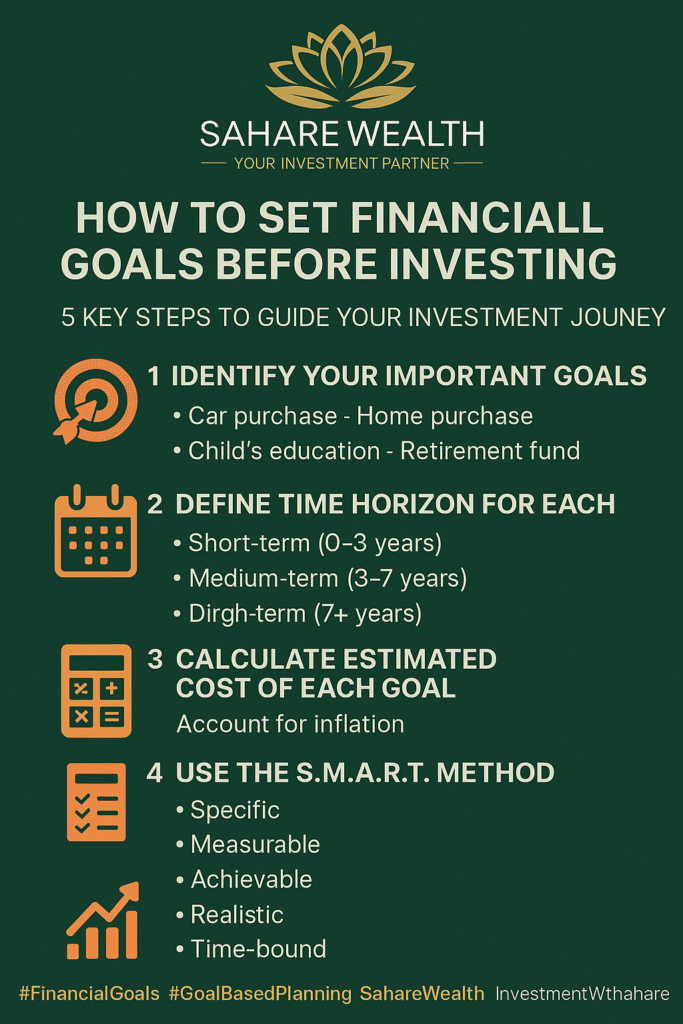
In today’s fast-paced financial world, investing without clear financial goals is like sailing without a compass. Whether you’re a young professional, a business owner, or nearing retirement, setting well-defined financial goals is the first step toward financial freedom. Let’s explore how you can set smart, achievable goals before making any investment decisions.
🧭 1. Understand Why You’re Investing
Before diving into mutual funds, stocks, or real estate, pause and ask:
- What do I want to achieve?
- By when do I need this money?
- How much risk can I take?
Goals could include:
- Building an emergency fund
- Buying a house
- Children’s education
- Retirement planning
- Wealth creation or passive income
📊 2. Categorize Goals: Short, Medium & Long-Term
Short-Term Goals (0–3 years)
E.g., Vacation, emergency fund, buying a gadget.
💡 Invest in low-risk options like liquid or short-term debt mutual funds.
Medium-Term Goals (3–5 years)
E.g., Buying a car, children’s schooling.
💡 Consider hybrid or balanced mutual funds for moderate risk and growth.
Long-Term Goals (5+ years)
E.g., Retirement, child’s higher education, wealth creation.
💡 Equity mutual funds or SIPs are ideal here due to compounding benefits.
🎯 3. Make Your Goals SMART
Your goals must be:
- Specific
- Measurable
- Achievable
- Realistic
- Time-bound
📝 Example: “I want ₹10 lakhs in 10 years for my child’s college education.”
📐 4. Calculate the Cost of Your Goal
Consider:
- Current cost of the goal
- Inflation rate (usually 6–7%)
- Investment duration
💡 Use an online goal calculator or consult a financial advisor to get exact numbers.
💸 5. Link Each Goal with the Right Investment Product
Each goal demands a different investment strategy:
| Goal Type | Investment Option |
|---|---|
| Emergency Fund | Liquid Fund, FD |
| Car/Marriage (3-5 yrs) | Balanced Fund, Hybrid Fund |
| Retirement (10+ yrs) | Equity Mutual Funds, NPS |
| Passive Income | SWP from Debt/Hybrid Funds |
🧠 6. Review and Adjust Your Goals Annually
Life changes. So should your financial goals.
Set an annual reminder to:
- Check progress
- Reallocate investments if needed
- Update goals based on life events (marriage, child, job change)
🤝 Final Thought
A goal-based investment approach brings structure, discipline, and purpose to your financial journey. Don’t invest because others are doing it — invest because you have a well-thought-out goal and a plan to achieve it.
Need help setting your financial goals or choosing the right mutual funds?
📌 Let’s connect for a FREE Goal Planning Session today!